Flash rust is the thin orange film that creeps across bare steel within a few hours of blasting it down to clean metal — and here in Crescent City, with Crescent Lake on one side and the St. Johns River on the other, that film shows up faster than most folks expect. You blast a trailer frame to bright gray on a humid morning, walk off to grab a coffee, and by the time you are back it has a tan hue to it. That is flash rust, and it is not a sign someone did the work wrong. It is Florida doing what Florida does to raw iron.
We deal with it every week out here in fern country, so here is the honest version — what it is, why it happens so fast, and what actually beats it.
1. Flash rust is not deep rust — but it still matters
Flash rust is surface oxidation only, microns thin. It is not the flaking, pitting corrosion you scraped off in the first place. Wipe blasted steel with a rag and you will see the orange come off on the cloth. So if it is that shallow, why care? Because paint and primer want a clean, defined profile to grip. A heavy layer of flash rust sits between your fresh coating and the steel like dust on tape. The coating bonds to the loose rust instead of the metal, and a year later it lifts. The standard for visible flash rust grading comes from the surface-prep folks at SSPC — light, medium, and heavy — and on coastal and lake-country steel, where a job goes determines how strict you have to be about it.
2. Why bare steel rusts within hours in Putnam County
Rust is iron, oxygen, and water getting together. Two of those are always in the air. The third — water — is the variable, and around Crescent City the air is loaded with it. Lake and river humidity, afternoon storms rolling up off the St. Johns, mornings where dew sits on everything until ten o’clock. Bare blasted steel is chemically hungry: you just stripped away every bit of mill scale and old coating that was slowing the reaction down. Profile that fresh metal grabs moisture out of humid air almost on contact.
Salt makes it worse. Steel that lives near the water — dock framing, boat trailers backed into Crescent Lake every weekend, seawall hardware — carries soluble salts down in the pits. Blasting opens those pits up. If the salts are not rinsed and the steel is not primed quickly, flash rust comes in heavier and faster. That is the difference between a barn implement in Pomona Park and a trailer that gets dunked in the lake — same metal, very different rust clock.
Temperature plays in too. When the steel is cooler than the air — early morning, or a frame that sat in a shady barn aisle overnight — moisture condenses right onto the surface, the same way a cold glass of sweet tea sweats on the porch. Now you have got liquid water on bare metal before you have even mixed primer. We watch for that on the first job of the day, because the steel that feels cool to the hand is the steel that flash rusts first.
3. Same-day priming is the only thing that really beats it
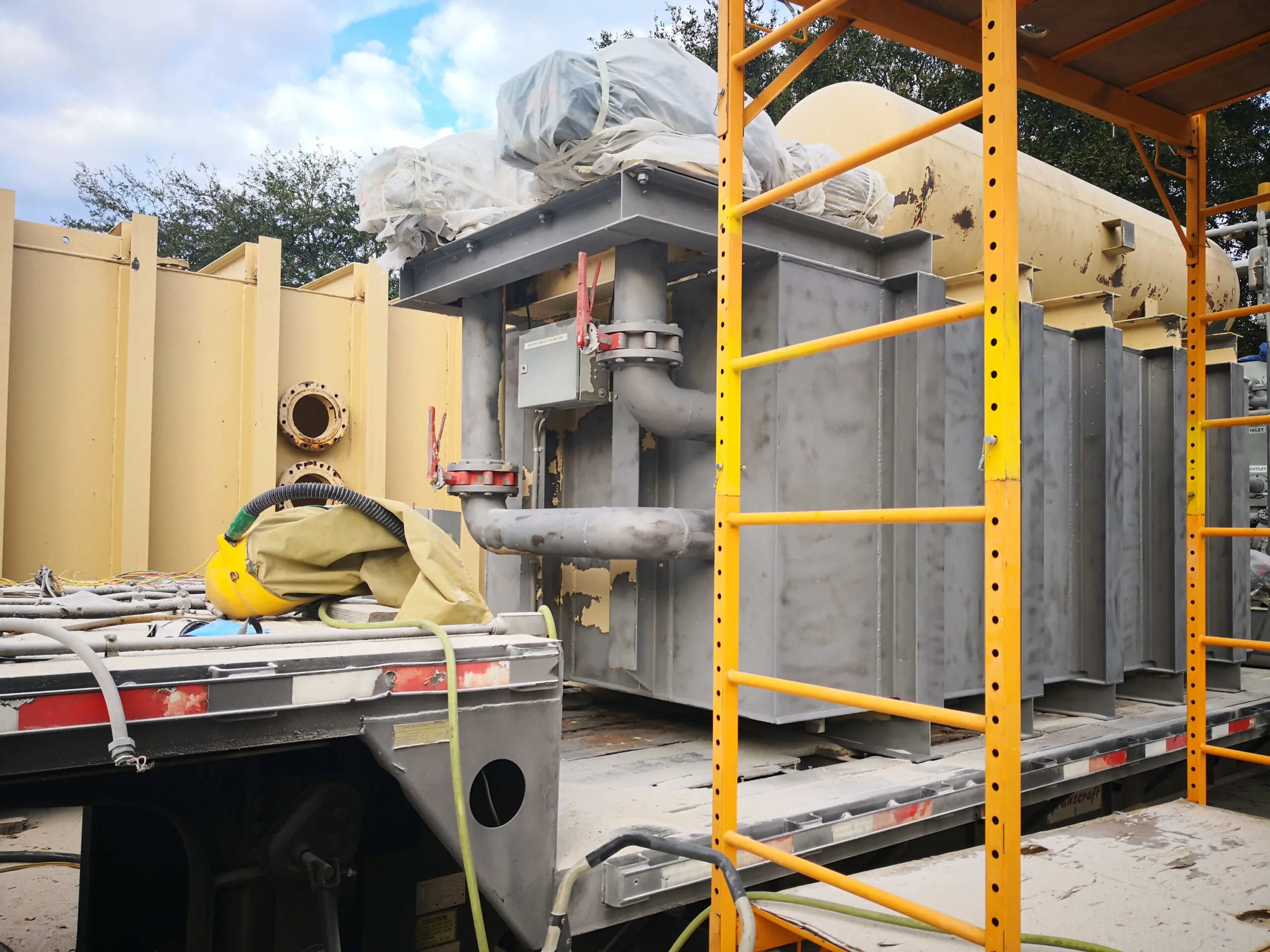
Here is the part most people skip: there is no magic abrasive that stops flash rust. The fix is timing. You blast and you prime the same day — ideally within a couple of hours, before the humidity gets a foothold. That is why we run blasting and coating as one job, same crew, same visit. When we do metal sandblasting in Crescent City, the goal is to never let that steel sit bare overnight in lake air. The rig blasts a section, we knock the profile clean, and the primer and coating go on while the metal is still bright.
Companies that subcontract the painting out, or blast on Friday and come back Monday, are handing your steel a whole weekend to flash rust in Putnam County weather. By Monday they are either re-blasting (and you are paying for it twice) or painting over orange. We would rather just do it in one pass.
4. Dustless blasting and the flash rust trade-off
Dustless and wet blasting are excellent for knocking down dust on lakeside jobs and for stripping big surfaces fast. But here is the honest trade-off: anything that puts water on the steel speeds flash rust up. You are adding the exact ingredient rust needs. Good wet-blast work uses a rust inhibitor in the water to buy you a window, but that window is hours, not days. If you ask us about green blasting in Crescent City, we will tell you straight when it is the right call and when dry blasting will serve you better — because on a job where the steel needs to stay bright for priming, dry is often the smarter pick. It trades one problem for another, and we will tell you which problem you would rather have.
5. When a little flash rust is fine — and when it is not
We are not going to pretend every speck of flash rust is a crisis. On some jobs, a light golden haze is acceptable under the coating system being used, and certain primers are formulated to tolerate it. If a wire brush and a clean rag will knock a light film back before priming, that is a normal part of the work, not a do-over.
What is not fine is medium-to-heavy flash rust under a high-performance coating, or any flash rust at all on salty waterfront steel headed for a long service life. On a dock piling bracket or a boat trailer that lives half its life in Crescent Lake, you want bright metal under that primer, full stop. The honest answer depends on the job — and a contractor who tells you flash rust “never matters” or “always ruins everything” is selling you a slogan, not the truth.
6. How we keep flash rust off your steel
Our routine is simple and it is built around the Florida clock. We check the weather and the dew point before we start. We blast in sections we can prime the same visit instead of stripping the whole piece and letting it stand. On salty steel we rinse soluble salts before the final blast so they are not trapped under the coating. And we keep the blast-to-prime window tight — the bright metal gets covered before the lake air can claim it.
A real example: a 30-foot gooseneck that gets launched at the Georgetown ramp most weekends came to us with rust blistering under old paint. The wrong way to handle that is to blast the whole frame Saturday and prime it Sunday. The right way — the way that keeps flash rust off salty steel — is to rinse the salts, blast a manageable run of the frame, and get inhibitor and primer onto that bright metal before moving down the rail. Slower? A little. But the coating is still on there, not peeling in the boat lift come next summer.
That is also why we are picky about scheduling around storms. Blasting a big frame at 2 p.m. with a thunderhead building over the St. Johns is asking for flash rust before the primer can go on. Sometimes the right move is to start early and beat the afternoon humidity. Little decisions like that are the difference between a coating that lasts and one that fails in a season. The crew at OSHA covers the safety side of abrasive blasting if you want to read up on how the work is done properly.
The short version
Flash rust is normal, it is shallow, and in Putnam County it is fast. You do not beat it with a special sand — you beat it with timing, by priming bright steel the same day before the lake and river humidity get to it. Match the media to the surface, keep the blast-to-prime window tight, and respect the Florida weather, and your steel goes from bare to protected without an orange middle step.
Need sandblasting in Crescent City or nearby? Call (386) 800-3366 for a free on-site estimate. You will reach someone who actually does the work.