
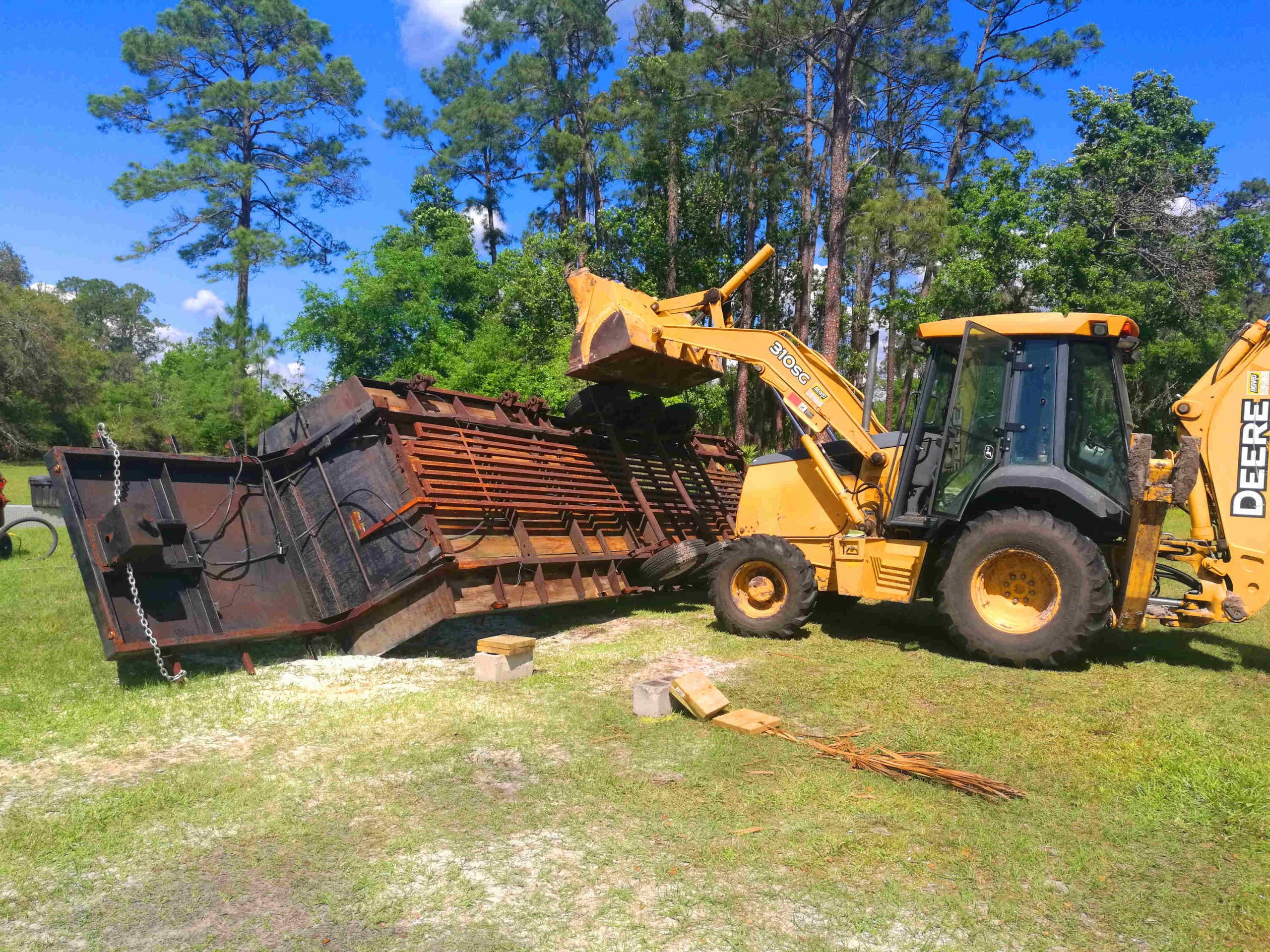
Trailer frame restoration is one of the most common calls we get in Crescent City, and it makes sense. Between the bass boats going in and out of Crescent Lake, the pontoons running the St. Johns, and the utility and fern-farm trailers working the rest of Putnam County, there are a lot of frames out here quietly rusting from the bottom up. Here is the part most people skip: the blasting is the fast part. The prep before the abrasive ever hits steel is what decides whether that frame lasts another fifteen years or starts bleeding rust through fresh paint by spring. These are the seven steps we walk through on every trailer that comes to us. Do them in order and the rest of the job almost takes care of itself.
1. Strip everything that is not frame
Lights, wiring harness, license plate bracket, reflectors, winch strap, jack wheel — all of it comes off. Abrasive does not care what it hits. It will frost a lens, chew through a wire loom, and peel the coating off a coupler you meant to keep. On boat trailers the bunks and rollers come off too, carpet and all. That carpet holds years of lake water against the crossmembers, and the steel underneath it is usually the worst on the whole trailer — you will not know how bad until it is bare.
If you want to save on labor, this is the one step a handy owner can do in a weekend with basic tools. We will happily do it for you, but we will also tell you straight: pulling your own lights is cheaper than paying us to pull them.
2. Degrease before anything gets blasted
This is the step nobody expects. Blasting does not remove grease and oil — it smears them, then hammers them down into the profile of the steel. No coating on the market sticks to oil, no matter how clean the metal looks afterward. Axle grease around the hubs, road film on the tongue, outboard drip down the rear crossmember: all of it gets degreased and rinsed before the rig fires up.
Trailers that live in the water have a second problem you cannot see — soluble salts sitting on the steel. Blast over them and they stay under your new paint, pulling moisture through the film from day one. A proper wash-down first is cheap insurance. On some old farm trailers we spend nearly as long degreasing as blasting. It is not glamorous work. It is also the difference between primer that bonds and primer that peels off in sheets.
3. Decide whether trailer frame restoration even pays
Here is the honest part most people skip. Not every frame is worth restoring. Before we quote anything we put a screwdriver and a hammer on the crossmembers, the spring hangers, and the frame rails near the axle. Surface rust — even heavy, scaly rust — blasts off fine. That is exactly what abrasive is for. But if the steel is rotted through, flaking in layers, or the hangers have gone lacy, blasting just makes the holes easier to see.
We have told more than one boat owner around Crescent City that the money was better spent on a new galvanized frame, and we would rather lose that job than blast a trailer that fails on the ramp with a boat sitting on it. If the bones are good — and most are — trailer frame restoration costs a fraction of replacement, and you end up with steel you have actually seen bare, which is more than you can say for anything rolling off a dealer lot.
4. Know what you have: painted steel vs galvanized
Painted steel is the easy call: blast to bare metal, prime, coat. Galvanized frames want more judgment. That dull gray zinc layer is doing its job even when it looks chalky and tired, and aggressive blasting strips it right off. If the galvanizing is mostly intact, we run a gentler media at lower pressure to clean and profile without cutting through — or we tell you to leave it alone entirely. Stripping healthy galvanizing off a trailer that dunks in the St. Johns every weekend is trading a coating that fights the river for a paint job that has to fight it alone. We match the media to the surface, same price either way — we pick by the job, never the invoice.
5. Pull or mask the hubs, tires, and anything rubber
Bearings and blast grit are natural enemies. On a full restoration the hubs come off completely — the spindles need blasting anyway and the bearings get repacked before reassembly, so nothing is wasted. Tires, lens gaskets, rubber bushings, and the coupler latch get masked heavy if they stay on. Grit finds its way into anything with a moving part, so we tape a trailer like it matters, because it does. Ten minutes of masking beats an afternoon of digging abrasive out of a hub.
Utility and farm trailers get one more step: the wood decking comes up. Pressure-treated boards bolted over the frame rails trap moisture against the steel the same way bunk carpet does, and the rail tops under old decking are almost always the rustiest steel on the trailer. Pulling the boards takes an hour with an impact driver and tells you the truth about the frame before any money changes hands. Most decking around here is at the end of its life anyway by the time the frame needs blasting — replacing it after the frame is coated is the cheap part of the job.
6. Pick the blast method for where the trailer sits
Most trailer frames want plain dry abrasive blasting. It is fast, it reaches into the hundred nooks a C-channel frame hides, and it leaves a bone-dry surface you can prime immediately. If the trailer is parked somewhere dust is a genuine problem — tight against a neighbor’s pool screen, inside a packed shop — dustless blasting keeps the cloud down. But be honest about the trade: dustless leaves the steel wet, and wet bare steel in Putnam County humidity starts hazing orange before supper. There are rust inhibitors for that and we use them, but a lot of the time, honestly, dry is the better choice for a frame.
Either way, the work follows the containment and respiratory practices OSHA lays out for abrasive blasting. Silica sand left our hoppers a long time ago — the media we run now cuts better and does not put crystalline silica in the air your family breathes.
7. Have the primer on the frame the same day
Freshly blasted steel is the most vulnerable it will ever be. With Crescent Lake on one side and river air on the other, a bare frame here starts flash rusting in hours, not days. That is why we do not blast a trailer we cannot prime the same day. Period. Our metal sandblasting crew and the coating crew are the same two hands — the frame gets its primer before the truck leaves, and the topcoat follows once it cures.
If someone else is doing your paint, fine — but make sure they can be standing there the day of the blast. A weekend gap between blast and primer quietly undoes half of what you paid for.
What the finished job looks like
The 30-foot trailer in the photo up top went through exactly this process: stripped, degreased, blasted to clean steel, primed the same day, and repainted. No shortcuts, no mystery — just the steps above, done in order. Because we handle the painting and coating ourselves, there is no gap between trades and no finger-pointing if something is not right. One crew, one trailer, one standard.
People ask how long all this takes. For a typical single-axle boat trailer: strip and degrease one day — yours or ours — then blasting, priming, and first topcoat the next. Bigger tandem frames and 30-footers run longer, but the rhythm is the same: never more hours between bare steel and primer than the humidity allows, which around Crescent Lake is not many.
If a wire brush and a Saturday will genuinely handle your frame, we will tell you that too. But if the rust is winning, do the prep right and the trailer will outlast the boat sitting on it.
Need sandblasting in Crescent City or nearby? Call (386) 800-3366 for a free on-site estimate. You will reach someone who actually does the work.