
A soda blasting engine job is the one we get asked about when somebody has an outboard, a mower deck, or an old lawn tractor motor so caked in grease and river grime that they cannot even tell what color it used to be. Around Crescent City and Putnam County that is a very real problem. Engines live in boat sheds on the St. Johns, in barns out in fern country, and on trailers parked a stone’s throw from Crescent Lake. Everything gets coated in oil, algae film, dirt dauber nests and years of humidity. Soda blasting is a good answer for a lot of that. It is also the wrong answer for plenty of it, and we would rather tell you which is which before you spend a dime.
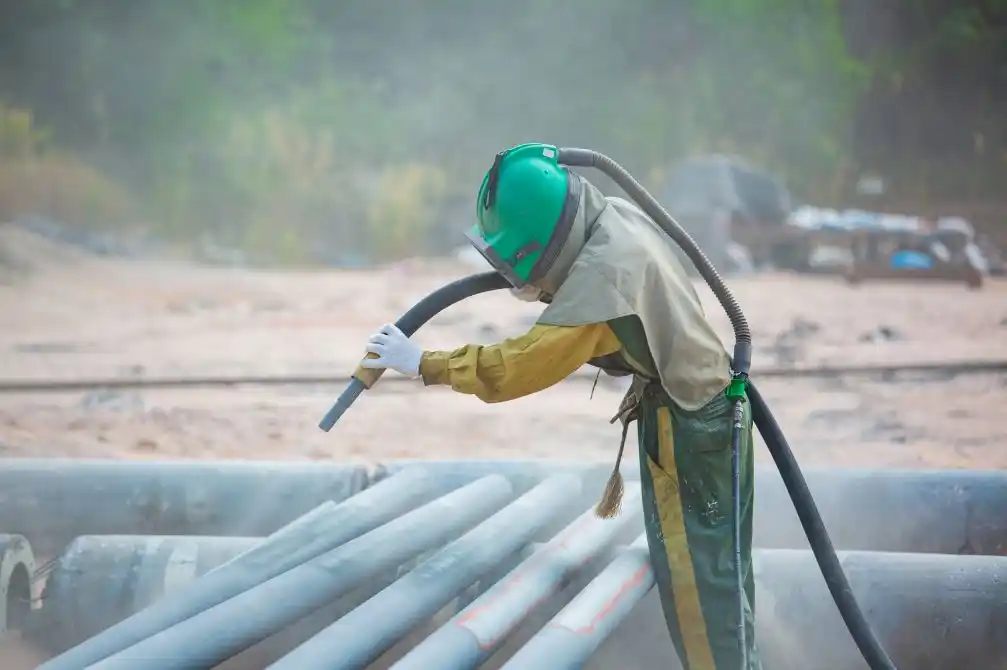
What a soda blasting engine job actually is
Soda blasting uses sodium bicarbonate, the same family of material as baking soda, as the abrasive. The crystals are soft. When they hit a surface they fracture and give up their energy to the coating or the grime instead of digging into the metal underneath. That is the whole trick. A hard abrasive like slag or garnet cuts. Soda lifts. On a soda blasting engine job, that means we can take grease, oil film, carbon smear, light paint and surface dirt off aluminum, magnesium, thin castings and painted housings without etching them, warping them or rounding off the fine detail.
Compare that to the heavy media we run on structural steel. Our guide to blasting abrasive types walks through why garnet, slag and glass bead each fit a different job. Soda sits at the gentle end of that range, and that is exactly why people reach for it around engines.
Why a soda blasting engine job beats a wire brush and solvent
The usual way people clean an engine is a can of degreaser, a stiff brush, a pressure washer and a bad afternoon. It works, sort of. The grease you can reach comes off. The grease packed into cooling fins, behind brackets and in the cast-in ribs does not. Worse, a pressure washer drives water and grit straight into places that were sealed against exactly that. Solvent runs down into the shop floor and into the ground.
Soda reaches into those fins and corners because it is a stream of tiny particles, not a bristle. It strips the film evenly and leaves the casting texture intact. For an outboard lower unit, a carburetor body, a valve cover, a transmission case or an old cast-aluminum pump housing, that even, non-cutting clean is the point. Nothing is scoured away that you wanted to keep.
6 proven rules for soda blasting an engine or outboard
If you are going to have a soda blasting engine job done, or you are just deciding whether it is worth it, these are the rules our crew works by.
1. Tear it down as far as is sensible first
Soda blasting is not a magic wand you wave over an assembled motor. The cleaner the part is separated from the things that cannot get bicarbonate in them, the safer the job. Pull the carburetor, the electrical components, the sensors and anything with exposed windings. Blast the bare housing, not the whole running assembly. If you cannot tear it down, tell us up front and we will talk about what we can mask and what we should not touch.
2. Mask every opening like it matters, because it does
Sodium bicarbonate dissolves in water and it does not belong inside an engine. It can foul oil, upset fuel systems and gum up passages. Spark plug holes, intake and exhaust ports, dipstick tubes, breather openings, oil fill ports, and shaft seals all get plugged or taped before a single particle flies. This step takes more time than the blasting itself. If a shop skips it, find another shop.
3. Match the pressure to the metal
The same bicarbonate can be run hot or gentle. Thin magnesium and soft aluminum castings want low pressure and a slow, patient pass. A heavier cast-iron block can take more. We set it by the part, not by habit. This is the same logic behind metal sandblasting in general: the media and pressure are chosen for the job in front of us, not for the convenience of the crew.
4. Know what soda will not do
Here is the honest part most people skip. Soda blasting does not remove real rust well. It does not cut through mill scale, thick baked-on enamel or heavy corrosion, and it leaves no anchor profile for new coating to grab. If your engine has a rusted cast-iron block or flaking steel brackets, soda is the wrong tool and it will just waste your time. For that, a harder media does the work, and we will say so. The soda blasting engine approach is for cleaning and gentle coating removal, not for rescuing neglected steel. If a wire brush and a Saturday will do it, we will tell you that too.
5. Rinse the residue, then dry everything
Bicarbonate leaves a fine white film. Left in place, it can pick up moisture in our humid air and cause trouble with whatever goes on next. Parts get washed and dried thoroughly before they are reassembled or coated. Skip this and you can end up with paint that will not stick and metal that starts fogging over. Plan on a clean, dry part before any primer goes near it.
6. Decide the finish before you blast
Soda leaves a clean, matte surface, but it does not prepare metal for a new coating the way a profiled steel surface does. If the plan is to repaint the housing, say so on the first call. For some parts we will follow soda with a light scuff or a different media so the coating has something to hold. Our painting services can handle the finish once the part is clean, so you are not hauling bare parts around hoping nothing flash rusts. Bare ferrous metal in Putnam County humidity can rust before supper.
Outboards, trolling motors and river-country gear
Living around Crescent Lake and the St. Johns means a lot of marine hardware. Outboard lower units come out of the water crusted with growth, old grease and oxidized aluminum. Trailer winches, bearing housings and bow rollers go the same way. A gentle clean on an aluminum lower unit shows you the casting underneath, including hairline cracks and corrosion pits that were hiding under the crud. That is useful. You want to find out the case is cracked before you reassemble it, not after the motor quits on the lake.
One caution for waterfront work. Do not let bicarbonate wash into the water or onto the soil near the dock. It will not poison a lake in the quantities involved in a single part, but we keep the work contained and cleaned up anyway. That is simply how a careful crew works near the river and near fern-country gardens, where runoff can end up in places you care about.
Lawn, farm and shop engines too
It is not only boats. Out in Putnam County we hear from people with old lawn tractors, chainsaw cases, generators, pressure washer pumps and small farm engines. Most of them show up with the same story: they are greasy, painted a color no one remembers, and the owner wants to see what is underneath before deciding whether to restore or replace. Soda blasting an engine like that tells you quickly. If the metal beneath is sound, restoration is worth discussing. If the casting is pitted through or cracked, you will know before you buy parts.
When soda is the wrong call and we will say so
Sometimes the better answer is not soda at all. A rusty steel trailer frame needs something heavier. Old paint on a brick chimney is a different problem, covered in our post on removing paint from brick. A greasy concrete shop floor is another matter altogether. Dustless wet blasting is often better when you need to keep dust down around a barn or boat shed, and you can read how it compares on our green blasting page. We would rather match the method to the job than sell you the one we happen to feel like running that day. You can also read more about our soda blasting service before you call.
Safety, dust and the rules that apply
Soda is gentler than most abrasives, but it is still airborne particulate, and the crew wears the right respiratory protection and eye protection every time. OSHA lays out the worker-protection basics at its abrasive blasting page. If an older engine or housing was painted before the late 1970s, the paint may contain lead, which changes how it has to be contained and cleaned up. Tell us how old the part is when you call.
What to have ready before you call
You do not have to prep anything, but a few details help us give you a straight answer on your soda blasting engine project. Tell us what the part is and what it is made of, if you know. Say whether it is assembled or torn down. Send a couple of photos showing the worst spots. Let us know what you want the finished piece to look like, bare and clean, repainted, or just degreased and put back to work. And if you suspect rust or cracks, say so, because that decides whether soda is even the right tool.
We will not promise an engine that never gets dirty again, and nobody honest will. What we can promise is that the right media goes on the right part, the openings are sealed properly, and you will know exactly what was done and why. That is how a soda blasting engine job turns a mystery lump of grease back into a part you can actually inspect and trust.
Need sandblasting in Crescent City or nearby? Call (386) 800-3366 for a free on-site estimate. You will reach someone who actually does the work.
Crescent City Sandblasting | (386) 800-3366 | https://crescentcitysandblasting.com/