Farm equipment rust removal is a call we get year-round in Crescent City, and it usually starts the same way. Somebody walks out to the pole barn, looks at a disc harrow or a bush hog that sat through one wet summer too many, and wonders if it is worth saving. Most of the time it is. Putnam County steel does not rust because farmers neglect it — it rusts because we park equipment a mile from Crescent Lake in air you can just about drink. Below are the six steps we follow to strip an implement to clean metal and coat it so it stays that way, plus an honest word on when you should not pay us at all.
Why Rust Eats Farm Equipment Faster in Putnam County
Three things gang up on steel around here. First, humidity — between the lake, the St. Johns River and the irrigation running through fern country, bare metal in this county almost never gets a dry day. Second, chemistry. Fertilizer dust, manure and the residue on anything that has worked a field are all corrosive, and they hold moisture against the metal like a wet rag. Third, the way farm equipment lives: it works hard for a season, then sits. Sitting is worse than working. A plow that turns dirt every week polishes itself; a plow parked under an oak from June to January grows scale you can peel off in sheets.
That is why farm equipment rust removal in Crescent City is rarely a cosmetic job. By the time rust shows through the paint, it is usually under the paint too, lifting it from the back side. Wire-wheeling the visible patches and repainting over the rest just buys the rust a hiding spot.
The equipment we see tells the county’s story. Disc harrows and bush hogs off the pastures between here and Pomona Park. Cattle gates and corral panels. Bucket loaders and box blades. Shade-house frames and irrigation stands from the ferneries down toward Pierson. Utility trailers that haul mowers all week and boats on Saturday. Different jobs, same enemy: steel, humidity and time.
Step 1 — Decide If the Implement Is Worth Blasting
Here is the honest part most people skip: not every rusty implement deserves the treatment. Blasting removes rust; it does not put steel back. If the frame on that old harrow flexes where it should not, or a screwdriver pushes through the sidewall of a box blade, abrasive will only make the holes easier to see. We have told more than one Putnam County farmer to spend the money on a replacement instead, and we will tell you the same if that is what we find.
On the other hand, heavy old iron — pre-1990 disc harrows, plows, cultivators, cattle gates, bucket loaders — was built with thick sections that shrug off decades of surface rust. Those are the best candidates we see. Scale and pitting look ugly, but if the metal underneath is sound, blasting brings it back to steel you can build a coating system on. And if all you have is one light-rusted gate? A wire brush, a rust-converting primer and a Saturday will do. You do not need us for that, and we would rather say so than take the job.
Step 2 — Degrease Before Any Abrasive Fires
Farm equipment carries grease, hydraulic oil and caked fertilizer in every seam. Blast over that and the abrasive drives contamination straight into the fresh surface profile, where it sits under the new paint and starts the failure clock early. So the first real work is not blasting at all — it is degreasing gearbox housings, wiping down hydraulic runs, and knocking the caked dirt off with a scraper and washdown. Soluble salts from fertilizer are the sneaky one: they are invisible, they pull moisture through cured paint, and no coating survives long on top of them. Clean first, blast second. Every time.
Step 3 — Match the Media to the Metal
An implement is three or four different metals bolted together, and good farm equipment rust removal treats them differently. The cast iron gearbox on a bush hog takes aggressive media without complaint. The sheet-metal deck and shrouds will warp if you lean on them with the same nozzle. Spring-steel tines and disc blades sit in between — you want the rust off without cooking the temper. We run coal slag or garnet on heavy frames and drop pressure or switch media on thin panels, and we mask what should not be blasted at all: hydraulic rams, seals, bearings, PTO shafts. That judgment is most of what you are paying for. The details on how we handle different metals are on our metal sandblasting service page.
Step 4 — Blast to Clean Steel, Not Shiny Rust
There is a difference between metal that looks better and metal that is actually clean. Rust that has been “blown over” quickly turns shiny and fools the eye, but the pits are still packed with oxide, and paint over packed pits fails from the bottom up. We blast to a commercial-grade clean surface — the pits opened up and emptied, the scale gone, a uniform gray profile the primer can bite into. On safety: abrasive blasting is regulated work, and the dust off old paint is nothing to breathe. OSHA publishes the standards we work under at osha.gov/abrasive-blasting, and if a coating is old enough to be suspect for lead, we test before we strip. Worth asking about, whoever you hire.
Step 5 — Prime Before Supper
Bare steel in Putnam County starts flash rusting before supper — sometimes within a couple of hours if a lake breeze is moving damp air across it. That gold-brown haze is new rust, and priming over it wastes the whole blast. This is the main reason we blast and coat with the same crew on the same day: nobody is waiting on a painter to show up Tuesday while your clean steel goes brown in the barn lot. The rig strips the implement in the morning and the primer is on before the humidity gets its turn. What we coat with and how is covered on our painting services page.
Step 6 — Choose a Coating That Survives Fertilizer and Lake Air
A rattle-can topcoat is not a coating system, and on farm equipment it will not last a season. What lasts here is a proper build: a zinc-rich or rust-inhibitive primer on the blasted profile, then a direct-to-metal enamel or urethane laid at the right thickness. On working surfaces — disc blades, plow shares, bucket edges — we skip the topcoat entirely, because dirt will strip it the first day back in the field; those get primer on the non-wear faces and honest bare steel where the ground does the polishing. Underneath and inside box sections, more film thickness, not less. That is where the lake air lives.
The Part That Saves You the Haul
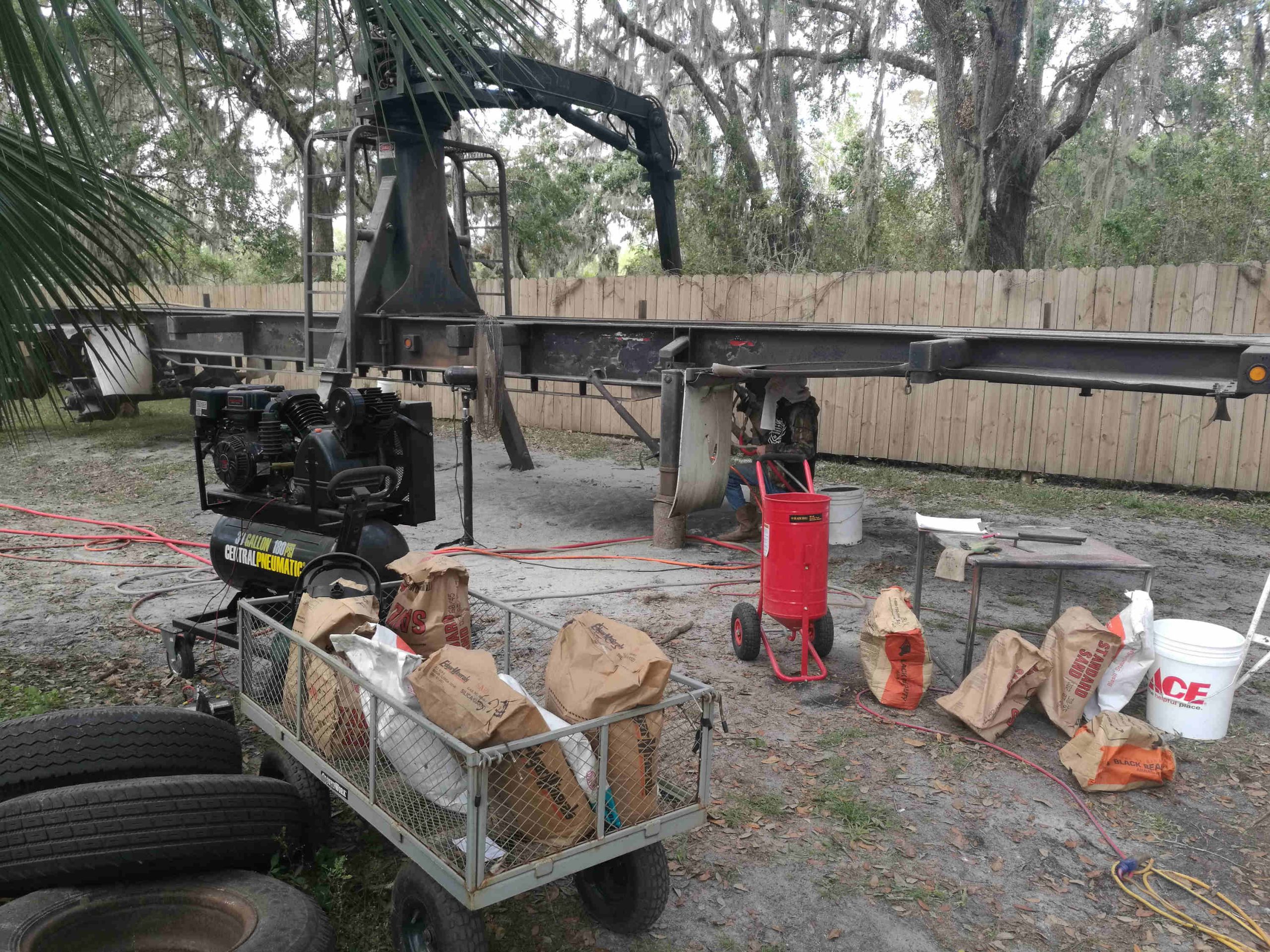
The rig comes to the farm. That matters more with implements than with anything else we blast, because nobody wants to load a 12-foot harrow on a trailer and drag it up US-17 twice. We set up in the barn lot or the field edge, contain the mess, blast, prime, and leave you with equipment parked back where it was — protected instead of rusting. If dust is a concern near the ferneries or close quarters, ask us about dustless blasting and we will tell you straight whether your job actually wants it, because a lot of the time dry is the better choice.
One crew, no finger-pointing: the people who blast your equipment are the people who coat it, and the person who answers the phone is one of them.
Need sandblasting in Crescent City or nearby? Call (386) 800-3366 for a free on-site estimate. You will reach someone who actually does the work.
Crescent City Sandblasting | (386) 800-3366 | https://crescentcitysandblasting.com/ — serving Welaka, Georgetown, Satsuma, Pomona Park, Pierson and all of Putnam County.